

4x2 Timber Treated
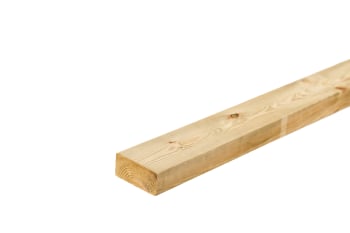
(13 Products)4x2 timber (47x100mm) provides the fundamental load-bearing framework for structural construction. Available in robust C16 timber and C24 timber grades, these kiln-dried and treated wood sections offer superior dimensional stability and natural resilience, making them essential for creating dependable partition walls, floor frameworks, and exterior decking bases.
Understanding 4x2 Treated Timber
Nominally sized at 47x100mm, this dimension represents one of the most widely specified profiles in the UK building trade. Through careful kiln-drying, the wood's moisture content is significantly reduced, which improves its dimensional stability and ensures the timber remains straight during installation while minimising post-installation shrinkage. The finished, uniformly planed edges allow for safe site handling and precise, tight-fitting joints across all structural applications.
Structural integrity is critical in construction, which is why these materials are strictly strength-graded. Standard C16 grading provides excellent, cost-effective strength for general framing tasks. For projects demanding superior load-bearing capacity and reduced deflection, premium C24 timber is sourced from slower-grown trees. This yields a tighter grain structure, fewer knots, and enhanced overall rigidity.
To guarantee longevity in varied environments, these profiles undergo a high-pressure preservative. This treatment deeply penetrates the wood fibres, creating a highly robust barrier against fungal rot, natural decay, and wood-boring insects. This preservation process renders the timber highly durable, ensuring long-term structural security even when exposed to atmospheric moisture or challenging outdoor conditions.
Material Range
- Treated Structural Timber: Featuring high-pressure preservation, this range offers a durable defence against moisture and insects for external framing, roof structures, and decking subframes.
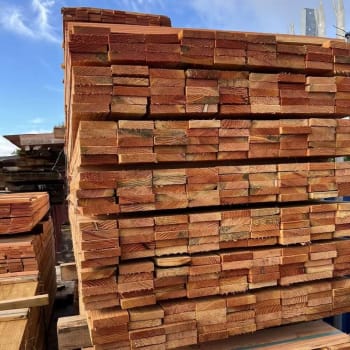
- Bulk Timber Packs: Designed for large-scale projects, packs of 4x2 timber supply high volumes of structural wood for expansive developments, ensuring consistent on-site availability.
Size Selection Guide
Choosing the right length minimises wastage, reduces off-cuts, and ensures structural integrity by avoiding unnecessary joints. For standard room heights, a 2.4m length is ideal for vertical wall studs in internal partitions. When building slightly taller frames or small garden structures, our 3m lengths or 3.6m sections offer the required vertical reach. For medium-span applications such as shed roofs or heavy-duty decking bases, the 4.2m timber and 4.8m lengths provide continuous, uninterrupted support. For spanning ceiling joists in large extensions or expansive commercial frames, you may require continuous long-reach spans like our 5.4m lengths or maximum 6m options.
Maximum Spans for 4x2 Joists
Understanding safe load-bearing limits is crucial when specifying joist timber for floor or ceiling structures. While actual spans depend on the dead and imposed loads of your specific project, standard TRADA guidelines provide a reliable baseline. For domestic floor joists spaced at 400mm centres, a C16 graded 4x2 can safely span up to 1.83 metres.
Upgrading to a C24 graded 4x2 at the same 400mm spacing increases the permissible clear span to approximately 2.05 metres. If your required span exceeds these limits, you must increase the timber depth and switch to heavier profiles such as 5x2 timber or 6x2 timber. Always verify final structural calculations with a qualified structural engineer.
Performance Benefits
- Load-Bearing Capacity: Kiln-dried and structurally graded to ensure reliable, safe performance in weight-bearing frameworks.
- Dimensional Stability: Controlled moisture reduction minimises the risk of warping, twisting, and splitting both during and after installation.
- Biological Resistance: Treated profiles provide guaranteed protection against wood-destroying fungi and insect attacks.
- Workability: Uniformly planed finishes with eased edges allow for precise measuring, clean cutting, flush fitting, and safe handling.
Typical Applications
- Internal Stud Walls: Constructing robust, load-bearing and non-load-bearing partition frames for domestic and commercial interiors.
- Floor and Ceiling Joists: Creating supportive frameworks for short-span domestic flooring and ceiling structures.
- Roofing Components: Forming structural roof trusses, rafters, and supporting purlins in traditional pitched roof construction.
- Decking Frames: Building highly durable subframes, bearers, and support structures for exterior garden decking.
Installation Guidance
- Moisture checking: Allow the timber to acclimatise to the environment prior to installation to prevent excessive movement.
- Cutting and sealing: Apply an appropriate end-grain preservative to any cross-cuts, notches, or boreholes to maintain protection.
- Fixing selection: Use corrosion-resistant nails, screws, or structural brackets to secure the timber firmly in place.
- Load distribution: Ensure appropriate spacing between framing components according to structural calculations.
Specification & Standards
- BS EN 14081-1: Timber structures - Strength graded structural timber with rectangular cross section.
- BS EN 335: Durability of wood and wood-based products - Use classes of biological attack.
- BS EN 350: Durability of wood and wood-based products - Testing and classification of the durability to biological agents.
Related Materials and Construction Uses
4x2 timber forms the core skeleton of a build and seamlessly integrates with a wide array of secondary construction materials.
These structural frames act as the primary fixing point for plasterboard, plywood, and OSB sheathing in wall construction, while the 100mm depth creates an ideal cavity for installing acoustic and thermal insulation batts.
When used in external applications or roofing, the timber works directly alongside breathable membranes, vapour control layers, and exterior cladding systems to create a fully weatherproof and thermally efficient structural envelope.
Frequently Asked 4x2 Questions
Can I Paint 4x2 Treated Timber?
Absolutely! Painting treated timber wood will not only help you achieve your ideal aesthetic but also gives the wood an additional layer of protection, which is something you want. When painting pressure-treated wood, however, you must be careful.
Most 100mmx50mm timber is still “wet” and needs time for the chemicals permeating the wood to settle and dry. At this point, the wood is noticeably heavy and will still feel damp to the touch.
If primer or paint is added to it at this point, there is every likelihood that it will be rejected by the water-based chemicals that are still working their way through the wood.
It is important to permit the timber to dry out fully before attempting to add paint or primer. This can be a lengthy process and may even take up to a few weeks depending on where the wood is stored.
If there is too much heat and direct sunlight, this can cause the treated timber to warp instead of dry out. Damp conditions can also prolong the drying-out period.
How Can I Tell if 4x2 Wood is Treated?
There are a few indicators that 4x2 timber has been pressure treated. The first is that it should be labelled as such with a stamp. However, when timber is cut to size, this occasionally gets removed.
Another tell is the colour of the timber; treated wood that is still relatively new should have a green tinge to it. This green hue fades over time and becomes honey gold before turning silver.
The smell can also be an indication, but this is only really effective when the wood is relatively fresh. New pressure-treated wood will carry a slight chemical smell, whereas non-treated wood won't. Again, this isn't a foolproof method and only works on freshly treated timber.
What's The Difference Between 4x2 Treated Timber & 4x2 Sawn Timber?
4x2 Sawn timber is wood that has been cut to the required dimensions but hasn't yet been pressure treated and kiln dried. 4x2 Pressure-treated timber, otherwise known as tanalised timber, provides many benefits, such as resistance to the elements.
The goal of pressure treating wood is to force preservative chemicals deep into the timber's cellular structure. This pressure treatment process will often include copper and organic co-biocides, which help to repel both insects and moisture.
Is 47x100 Treated Timber Environmentally Sustainable?
All of the timber lengths sold by Materials Market has been responsibly sourced.
Related Articles

Complete Guide to 4×2 Timber: Sizes, Grades & Uses

6×2 Timber: Choosing the Right Grade for Structural Work

How To Build A Decking

How To Build A Stud Wall

How To Build A Pergola

How to Build a Timber Frame Extension

Timber Frame Construction

Timber Sizing

C16 vs C24 – What’s The Difference?