

Skirting Board
(41 Products)Skirting boards provide a robust architectural transition between floor and wall, protecting masonry and plasterwork from impact while concealing expansion gaps. Available in a variety of timber and primed MDF profiles, these mouldings ensure a professional, durable finish for any interior environment.






Understanding Skirting Boards
Skirting boards are essential interior mouldings designed to bridge the junction between the wall surface and the floor. Their primary function is protective; they act as a barrier against scuffs, vacuum cleaner impacts, and furniture damage that would otherwise degrade the base of the wall. Beyond durability, they serve a critical structural role by masking the necessary expansion gaps left between flooring materials and walls, particularly in timber or laminate installations.
The composition of these boards varies to suit specific installation requirements. Choosing high-quality MDF skirting boards provides superior stability in environments like kitchens and bathrooms, preventing the warping or swelling often associated with high humidity. Alternatively, softwood timber mouldings offer natural aesthetic appeal and structural grain strength, allowing for bespoke finishes through staining or painting.
Precision-machined to consistent profiles, these boards ensure uniformity across large-scale developments or individual room refurbishments. Whether opting for traditional decorative curves or contemporary minimalist lines, the material provides a flat, stable surface for secure fixing via high-strength adhesive or mechanical fastenings.
Material Range
- Pencil Round: A clean-lined, modern profile featuring a smooth, small-radius rounded edge at the top front of the board, offering a subtle finish often found in modern residential builds.
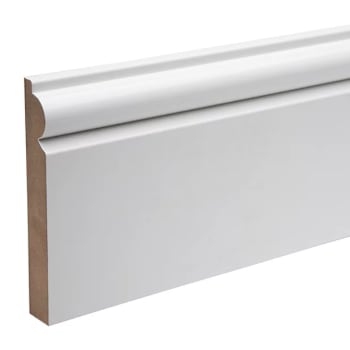
- Torus: A classic architectural style featuring a semi-circular convex moulding, frequently specified for traditional or period-style interiors.
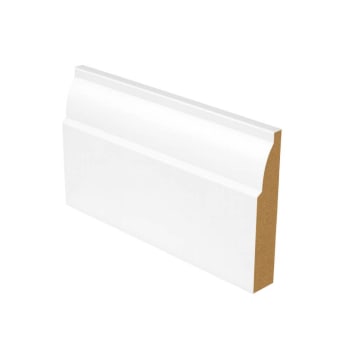
- Ogee: A decorative profile characterised by a distinctive S-shaped curve that transitions into a flat face, providing a sophisticated aesthetic for formal spaces.
- Square Edge: A minimalist, sharp-edged profile that provides a crisp, contemporary appearance and is ideal for commercial or high-concept residential projects.
- Ovolo: An elegant design featuring a classic curved arc that tapers back towards the wall, offering a softer transition than standard square-edged profiles.
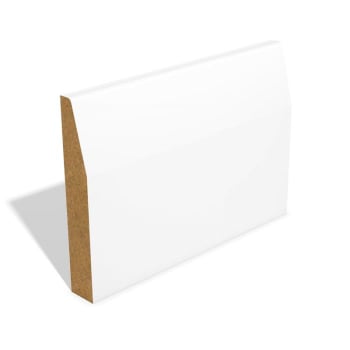
- Chamfered: A sleek, functional profile with a single angled slope, designed for easy maintenance while maintaining a clean, professional line.
Performance Benefits
- Impact Resistance: Provides a physical buffer that protects wall finishes from mechanical damage and foot traffic.
- Gap Concealment: Effectively hides uneven flooring edges and essential perimeter expansion gaps.
Surface Stability: Engineered to resist warping and twisting, ensuring a flush fit against the substrate. - Aesthetic Versatility: Ready for immediate finishing with either solvent or water-based paints and stains.
Typical Applications
- Perimeter Finishing: Closing the gap between floor finishes and plastered walls in residential and commercial rooms.
- Wet Room Integration: Using moisture-resistant variants to provide durable skirting in high-humidity zones like bathrooms.
- Renovation Projects: Covering imperfections at the base of old walls to provide a clean, updated appearance.
- Cable Management: Selected profiles allow for the discreet routing of low-voltage wiring behind the board face.
Specification & Standards
- BS 1186-3: Timber and workmanship in joinery. Specification for wood trim and its fixing.
- BS EN 622-5: Fibreboards. Specifications. Requirements for dry process boards (MDF).
- BS EN 942: Timber in joinery. General requirements.
Related Materials and Construction Uses
Skirting boards are frequently installed in conjunction with other internal timber components to create a cohesive interior envelope. They are commonly paired with matching architraves to frame doorways and window reveals, ensuring a consistent design language throughout the property. During installation, these boards work alongside high-grab adhesives and gap fillers to ensure a seamless bond to the substrate.
In flooring installations, they are essential for covering the expansion voids required by laminate, engineered wood, and solid timber floors. They can also be integrated with vapour control layers and underfloor heating systems where perimeter insulation strips need to be concealed.
Frequently Asked Skirting Board Questions
What Is The Standard Height For Skirting Boards In The UK?
Most skirting boards in the UK range between 120mm and 220mm in height, with 145mm (approximately 6 inches) being a common standard.
Should Skirting Boards Be Painted Before Or After Installation?
Skirting boards are usually easier to paint before installation, especially if you're using a different wall colour. A final touch-up coat can be applied once they’re fixed in place.
What’s The Best Adhesive For Fitting Skirting Boards?
A strong grab adhesive like Gripfill or No More Nails is ideal for bonding skirting boards to walls. For uneven walls or heavier profiles, mechanical fixings (screws and plugs) may be required.
Do I Need To Use Sealant Between The Skirting And The Wall?
Yes, applying a decorator’s caulk or flexible filler between the top edge of the skirting and the wall helps create a seamless look and covers minor gaps or imperfections.
Can Skirting Boards Be Used With Underfloor Heating?
Yes - skirting boards are compatible with underfloor heating systems, but ensure materials like MDF are moisture-resistant to avoid warping in warm, humid environments.
How Do I Join Skirting Boards In Corners?
For internal corners, a technique called ‘scribing’ gives the cleanest join. This involves cutting the profile of one board to fit snugly against the face of the adjoining board.
Are Skirting Boards The Same As Interior Mouldings?
The term 'interior mouldings' encompasses a wide array of decorative elements that add detail and definition to the edges and surfaces of projections or cavities.
From skirting boards that outline the base of walls, to architraves that frame doorways, mouldings are an essential component in any home design scheme.
Related Articles

How To Remove Skirting Boards