

C16 Timber
(37 Products)C16 timber provides a cost-effective and reliable structural solution for internal framing, stud partitions, and light-to-medium duty load-bearing applications. Available in 3x2, 4x2, and 5x2 sizes, these sections are kiln-dried and strength-graded to ensure performance and dimensional stability in domestic and commercial construction.
While this standard kiln-dried grade is perfect for assembling internal stud partitions and general framework, wide roof trusses or heavy-duty floor joists often dictate a higher structural classification. For projects demanding superior load-bearing capacity over extended spans, upgrading to premium C24 timber provides the necessary structural integrity. This high-density, slow-grown softwood features a tighter grain and fewer natural defects, allowing it to safely support greater dead loads while fully complying with the strict BS EN 338 grading standards required for heavy structural engineering.
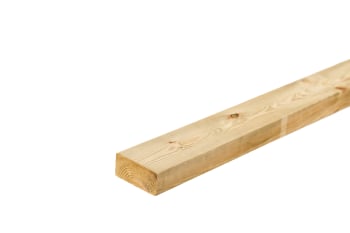


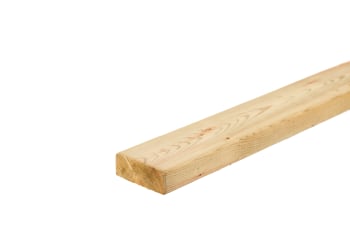
Understanding C16 Timber
C16 timber is a widely used grade of structural softwood in the UK, favoured for its versatility and ease of handling. The "C" classification denotes coniferous (softwood), while "16" refers to its characteristic bending strength. While slightly less dense than the C24 grade, C16 offers the necessary mechanical properties for the vast majority of internal structural tasks, providing a balance of strength and value.
The range focuses on common 2-inch thicknesses, providing essential components for wall and floor carcasses. The 3x2 and 4x2 sections are the industry standard for constructing internal stud walls and partitions, offering a slim profile that maximises internal floor space while maintaining a rigid frame. The 5x2 sections provide increased depth, making them suitable for rafters or joists where longer spans or higher loading capacities are required compared to the smaller dimensions.
To ensure long-term performance, all C16 timber in this range is kiln-dried. This process reduces the moisture content of the wood, which minimises the risk of warping, twisting, or splitting after the timber has been fixed in place. Each length is strength-graded, typically by machine, to meet the strict safety requirements of British building standards.
Material Range
- 2-Inch Structural: Kiln-dried, strength-graded timber available in standard dimensions including 3x2 CLS, 4x2, and 5x2 C16 Timber for framing and structural carcasses.
Performance Benefits
- Structural Reliability: Graded to C16 standards to ensure predictable mechanical performance under load.
- Dimensional Stability: Kiln-drying reduces moisture-related movement, ensuring frames stay straight and true.
- Ease of Use: Softwood composition allows for easy cutting and fixing on-site with standard power tools or hand tools.
- Regulatory Compliance: Meets the required strength classifications for residential and light commercial structural use in the UK.
Typical Applications
- Stud Partitions: Creating the internal skeleton for non-load-bearing and load-bearing internal walls.
- Roof Rafters: Providing the structural support for pitched roofs in smaller-scale extensions or domestic dwellings.
- Floor Joists: Forming the horizontal framework for floors where span requirements fall within C16 parameters.
- Timber Framing: Constructing the primary framework for sheds, outbuildings, and timber-frame extensions.
Specification & Standards
- BS EN 14081-1: Timber structures. Strength graded structural timber with rectangular cross section.
- BS EN 338: Structural timber. Strength classes.
- BS 5268-2: Structural use of timber. Code of practice for permissible stress design, materials and workmanship.
Related Materials and Construction Uses
C16 timber is primarily used to create the internal "hidden" structure of a building. It is commonly used in conjunction with OSB or plywood sheathing to provide lateral stability to the frame. For internal partitions, these timbers are typically clad with moisture-resistant or standard plasterboards and filled with acoustic insulation to improve sound reduction between rooms.
In flooring or roofing applications, C16 sections are often secured using galvanised steel hangers and framing clips. To ensure the longevity of the timber, it should be used alongside damp-proof membranes when in proximity to masonry, and treated with appropriate preservatives if there is any risk of exposure to damp environments during the build process.
Related Articles

How To Build A Decking

How To Build A Stud Wall

How To Build A Pergola

Timber Sizing

C16 vs C24 – What’s The Difference?