

Plasterboard & Drywall Adhesive
(3 Products)Plasterboard adhesives and bonding agents provide high-strength adhesion for securing drylining boards to masonry and uneven substrates. This range includes gypsum-based bonding compounds and high-grip grit primers, specifically engineered to ensure structural stability and a level finish on internal wall applications.
Understanding Plasterboard Adhesive
Plasterboard adhesive and bonding solutions are essential for modern drylining, primarily utilised in the "dot and dab" technique. This method allows for the direct enrichment of masonry walls, bypassing the need for traditional wet plastering and significantly reducing project timelines. These materials are formulated to bridge gaps in uneven substrates, providing a plumb and level surface for subsequent decorating.
The inventory features heavy-duty gypsum bonding compounds alongside high-performance primers designed to enhance mechanical grip. By creating a reliable interface between the substrate and the board, these products mitigate the risk of delamination and ensure a permanent bond. They are particularly effective when upgrading thermal performance or lining solid walls where timber battening is not feasible.
For successful installation, these adhesives offer a manageable open time, allowing for the precise positioning of boards using a straight edge or spirit level. Once set, they form a rigid, durable connection that supports the weight of standard, moisture-resistant, and insulated boards alike.
Material Range
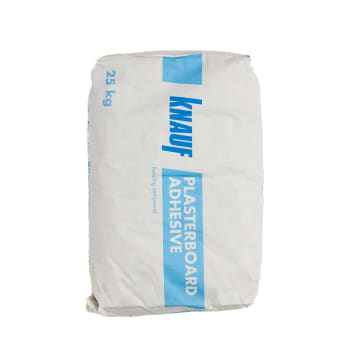
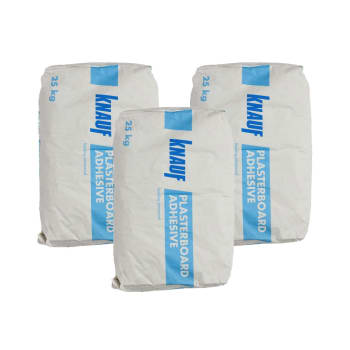
- Bonding Compounds: High-adhesion gypsum-based powders designed for the direct-bond method, featuring solutions such as Knauf Plasterboard Adhesive. These are available in single 25kg bags or full pallets for large-scale developments.
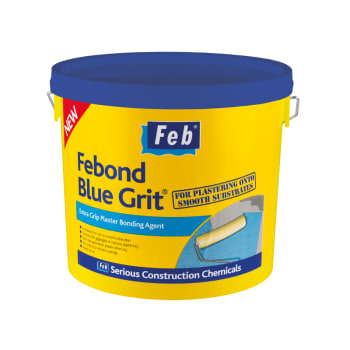
- Bonding Primers: Specialist grit-based coatings, including Febond Blue Plasterers Grit, which are applied to smooth or low-suction backgrounds to provide an improved mechanical key for the adhesive.
Performance Benefits
- High Bond Strength: Engineered to support the weight of heavy drylining boards on various masonry substrates.
- Gap Filling: Capable of levelling uneven walls by compensating for variances in the substrate surface.
- Rapid Installation: Facilitates the direct-bond method, which allows for faster decorating compared to traditional two-coat plastering.
- Workability: Formulated to provide sufficient "grab" while remaining adjustable for accurate board alignment.
Typical Applications
- Direct Bond Lining: Applying dabs of adhesive to masonry to fix wallboard or moisture-resistant plasterboard.
- Thermal Upgrades: Securing insulated plasterboard to external-facing solid walls.
- Substrate Preparation: Using grit primers to prepare high-density concrete or glazed surfaces before adhesive application.
- Acoustic & Fire Lining: Installing soundproof or fire-rated boards in commercial and residential partitions.
Specification & Standards
- BS EN 14496: Gypsum-based adhesives for thermal/acoustic insulation composite panels and plasterboard.
- BS EN 13963: Jointing materials for gypsum boards.
- BS 8212: Code of practice for drylining and partitioning using gypsum plasterboard.
Installation Guide: The Dot and Dab Method
For a detailed breakdown of the drylining process, refer to our guide on dot and dab.
- Preparation: Ensure the substrate is dry, dust-free, and stable. Apply a grit primer if the surface is exceptionally smooth or non-porous.
- Mixing: Combine the bonding compound with clean water in a mixing bucket. Use a mechanical paddle until a thick, creamy, "lump-free" consistency is achieved.
- Application: Apply the adhesive in dabs approximately 50mm to 75mm wide and 250mm long. Dabs should be spaced at roughly 300mm centres.
- Continuous Beads: Apply a continuous bead of adhesive around the perimeter of the wall and around any openings (windows/doors) to comply with fire safety and acoustic regulations. A continuous line should also be applied at the floor level to support skirting fixings.
- Board Fixing: Press the plasterboard firmly against the dabs and use a straight edge to tap the board into a plumb position.
Related Materials and Construction Uses
Plasterboard adhesives are used as part of a wider drylining system. They are frequently used in conjunction with foil-backed plasterboard to manage moisture or alongside secondary mechanical fixings when installing heavier boards on ceilings. Once the adhesive has cured, the installation is typically completed using jointing compounds, paper tapes, and corner beads to create a seamless surface ready for final skimming or direct decoration.
Frequently Asked Plasterboard Adhesive Questions
How Do I Choose The Right Adhesive For My Project?
There are a few things to consider when choosing the right plasterboard adhesive.
The first is the type of wall you're working with. If your wall is masonry, then dot and dab will be the easiest way to fix the plasterboard.
If your wall is made of wood or metal studs, then you should use a different technique, such as screwing or nailing the boards into place.
You’ll also need to take into account the weight of the plasterboard. If the board is too heavy, then the dot and dab may not be strong enough to attach the plasterboard and hold it in place. In this case, you may want to screw or nail the boards into place for additional security.
Also, in some fire-rated or high-rise applications, dot and dab may not comply with building regulations due to potential voids behind the boards. Always check local building codes.
For those wanting to save time, fast-curing adhesive foam offers a more rapid installation process. Although it is performatively the same as drywall adhesive, it requires no mixing prior to application.
How Thick Should Plasterboard Adhesive Be?
The standard thickness of adhesive dabs tends to be around 10mm once compressed between the board and the substrate.
You also have the additional 12.5mm of the plasterboard sheets on top of this so, with thicknesses combined, you can expect an altogether depth of around 22.5mm.
Related Articles

How To Fix Plasterboard